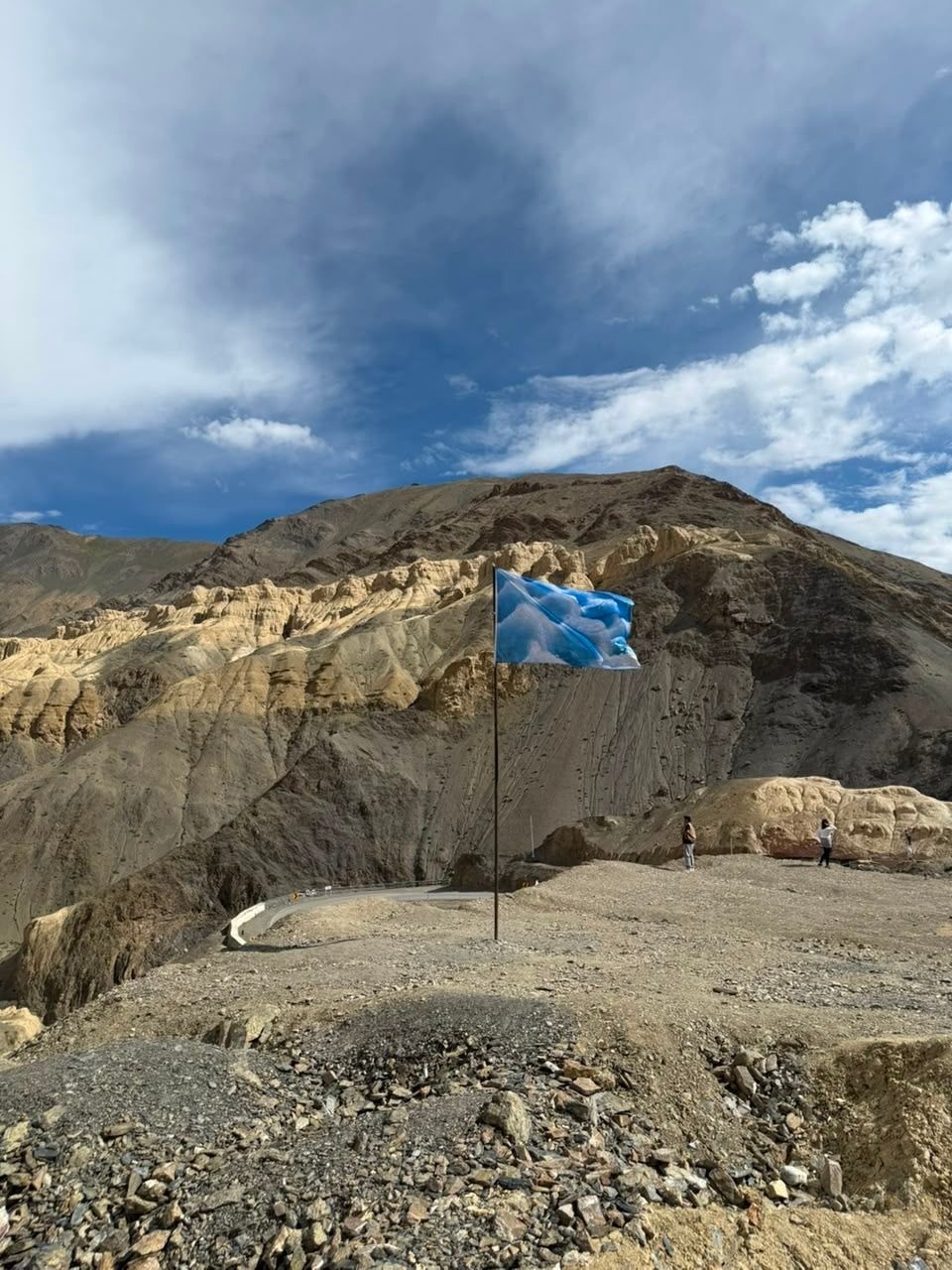
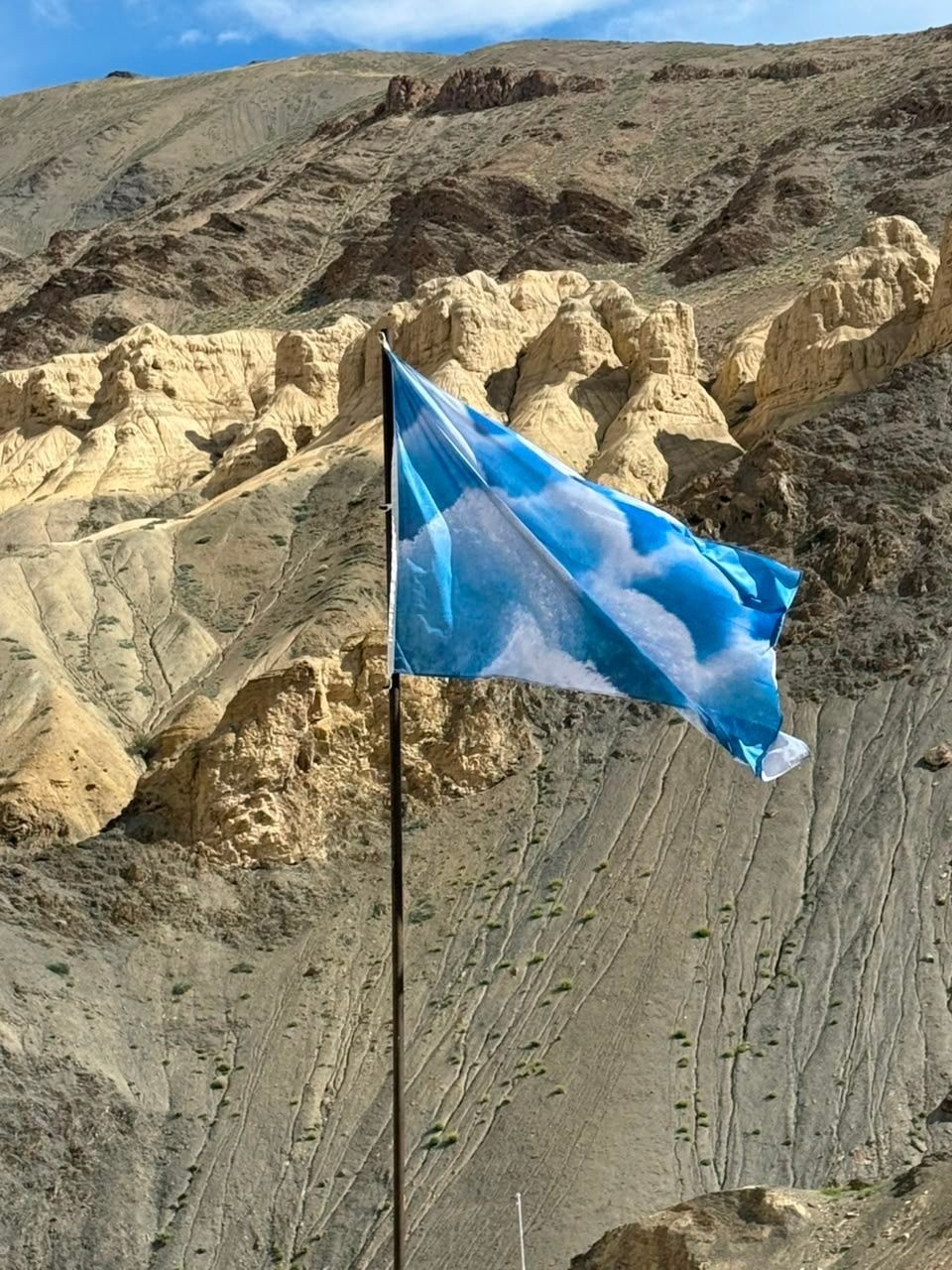
Flags often symbolise identity and community, belonging, borders, resistance, and protest. What do you hope your flag installation communicates?
Personally, I relate the flag to Buddhist prayer flags. In our tradition, prayers printed on prayer flags are carried by the wind, spreading wishes of peace, compassion, and well-being to all sentient beings.
My flag carries the memory of snow that has long since melted. It draws attention to glaciers and snow in the Himalayas, which are vital sources of water for millions of people. Through this work, I hope to encourage reflection on climate change, ecological fragility, and our shared responsibility toward the environment.
While the work is not a direct response to the student protests or political movements, it does resonate with broader questions of education. Addressing the climate crisis requires being educated in environmental awareness, sustainable ways of living, and having a stronger culture of reuse and care. In that sense, the work indirectly speaks to the importance of education in shaping a more responsible future.
How does your installation fit into the larger curatorial theme, ‘Signals from Another Star’?
The word sā (‘soil’ in Ladakhi) has always resonated with my practice, because soil and earth are fundamental to my materials and ideas. For me, ‘Signals from Another Star’ suggests messages travelling across time. This installation brings back an image I made four years ago and allows it to speak again in a new context.
The contrast between the image and its surroundings is important. The flag carries the memory of snow into a landscape dominated by rock, dust, and wind. That visual contrast invites viewers to think about changing climates, disappearing snow, and the ecological transformations taking place across the Himalayas. The work does not document one specific site. Instead, it connects different landscapes through memory.
Papier-mâché techniques with discarded paper, clay, and recycled egg trays sit at the core of your practice. What draws you to such raw materials that carry with them imperfections, markings of time, and memory of the hand?
Traditional Ladakhi homes are built from materials found in nature and are continuously repaired by reusing what already exists. This philosophy of care, repair, and reuse deeply influences my work.
I prepare my own papier-mâché using discarded paper along with a traditional binder made by boiling tamarind seed powder and lime (chuna) in equal proportions. I also use natural clay pigments collected in different hues. These methods draw from sustainable craft traditions practised in different parts of India.
The materials I use in my work, too, absorb time—they crack, soften or dissolve due to humidity or rise in temperature. I don’t see these changes as damage but as part of the cycle of life. This impermanence suggests that shelter, safety, and belonging are living processes. My artworks age and respond to their environment, much like landscapes and cultures adapting to ecological and social change.
Collecting these materials is an important part of my practice. It allows me to transform what is often considered waste into something meaningful.
This process reflects the traditional Ladakhi approach of repairing, reusing and extending the life of materials rather than discarding them. By giving these objects a new form, I hope to encourage us to reconsider our relationship with consumption, waste, and sustainability.
Do you think the biennale’s geographic location pushes artists to think differently?
Absolutely. Creating work in Ladakh requires artists to respond directly to its landscape, climate, communities, and culture rather than simply transporting ideas from elsewhere. The biennale also creates an important international platform for Ladakhi artists, allowing local knowledge, traditions, and environmental concerns to be presented within a global contemporary art context.
Do you see yourself documenting a disappearing way of life or imagining new possibilities for Ladakh’s future?
I see my practice doing both. It documents the knowledge embedded in traditional Ladakhi architecture and sustainable ways of living while also imagining how these values can inform the future. Rather than looking at tradition as something fixed or nostalgic, I see it as a living source of ideas for responding to contemporary environmental challenges. For instance, traditional Ladakhi homes are built using local materials, such as earth, stone, wood, straw. These materials are reused over generations, making the buildings naturally sustainable. I’m interested in the values this reinforces—repair, reuse, adaptability and living in balance with the environment.
Tashi’s participation is supported by Museum in Progress, the Austrian Embassy, Gujral Foundation, and the Quiet Art Movement. The 2026 sā Ladakh Biennale will run from August 1 to 10 across multiple sites following the Leh-Kargil route. The biennale is free and un-ticketed. More information can be found here