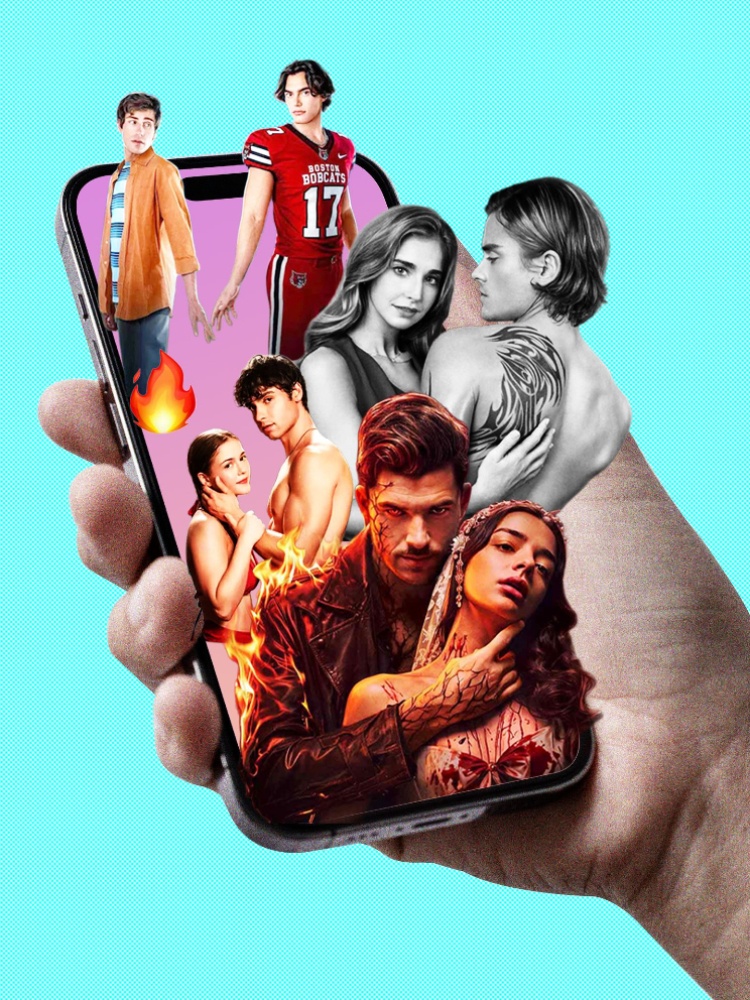

Instagram has a fairly good idea of what you like. It knows which ex you occasionally stalk, which skincare products you keep adding to your cart, and that you will, in fact, watch 17 videos of a dog doing absolutely nothing. It may also have noticed that you have a weakness for a man in a suit behaving terribly. Somewhere between your friend’s holiday dump and a recipe for chilli oil, your feed has started slipping in soft porn: slickly shot vertical episodes featuring kidnapped heiresses, mafia bosses, office affairs, and men whose idea of flirting seems to involve a questionable abuse of power.
Romance has always had its guilty pleasures. There were Mills & Boon paperbacks tucked under mattresses, dog-eared copies passed between friends, and, later, entire corners of the internet dedicated to increasingly elaborate romantic fantasies. Wattpad and fanfiction communities gave readers a place to indulge in stories that could be as dramatic, strange or spicy as they pleased. Now, the same appetite is being packaged into bite-sized videos, complete with attractive actors, dramatic music, and cliffhangers designed to make you forget what you were doing in the first place.
Take Vicious, for instance. In a clip from the show (inspired by the novel of the same name by LJ Shen) doing the rounds on Instagram, a man in a pinstripe suit drops his wallet in an office lift. As he bends to retrieve it, his hand brushes against a woman’s leg. The two exchange glances while other executives in the lift pretend to be occupied with their own business. The clip cuts just as the tension reaches its peak. It has clocked 5.8 million views and 34,400 likes, with viewers making their feelings known in the comments.
“It’s giving Fifty Shades LMAO.”
“I don’t know how Cam isn’t on the big screen yet.”
The clip has all the ingredients of a workplace HR nightmare, which is possibly why people can’t look away. It also illustrates the appeal of the new breed of content. These shows feature short, scripted episodes that are usually shot vertically for phone screens. But it’s really the smut genre within microdramas’ larger ecosystem that has really taken off.
The plots are mostly ridiculous. A millionaire disguises himself as an ordinary employee to test a woman, only to be rejected. A hotel heiress goes undercover as a housekeeper. A college student has a one-night stand with the campus’s most notorious frat boy and ends up pregnant. There are beastly husbands, secret identities, billionaires with questionable boundaries, and men who seem to regard the word “no” as the opening line of a negotiation. Apps such as ReelShort have turned this formula into a catalogue of its own. The titles offer a fairly reliable preview of the chaos within: Thirty Days with the Mafia Boss, The Bride They Gave the Beast, and The Mermaid’s Tear.
For Fiza Ahmed, 27, from Chennai, the format fits neatly into a life where sitting down with a book for a few hours can be difficult. “I used to write Hunger Games fan fiction on AO3. Now that I’ve grown up and I’m also a mum, I don’t really have the time to sit and read long fan fiction. Watching some of the better-produced content is just a fun distraction and gives instant gratification. I can do it while I’m commuting, with my AirPods on, sitting in a corner. It’s funny, it’s entertaining, and it doesn’t require me to pay much attention because it’s quite silly. After an exhausting day, sometimes all you need is something a bit absurd,” she says.
Ria Chopra, author of Never Logged Out: How the Internet Created India’s Gen Z, points to privacy as one reason people may be more comfortable watching sexually suggestive content on their phones than on a shared television.
“The phone is smaller, so you can go to your room, watch it under your blanket, hide away somewhere, versus watching something on a television, which is a public act. Especially in India, where so many of us live with our families, people can just walk in and see what you’re watching. Phones also give you a lot of control over deleting your watch history or watching in incognito mode. I wouldn’t want to watch anything even slightly sexually suggestive in a space where someone else might come across it. On my phone, which only I access, I can delete my watch history or lock my app on Instagram. I think that just makes it easier.”
The other advantage is how easily these dramas find their way to viewers. “The discoverability of something on Instagram is a lot more—you can find anybody, versus on television, where you have to specifically go and click on a film. On Instagram, it’s just easier to come across this kind of content if you end up watching one or two Reels. Then it starts being suggested to you too,” Chopra adds.
The business has been quick to recognise the opportunity. India has seen a growing crop of microdrama apps, including Kuku TV, Story TV, Quick TV, and My Drama (which offers a lot of spicy content). Earlier this month, Aamir Khan Productions and Excel Entertainment announced a partnership to launch a microdrama platform, with plans to develop original shows and bring existing intellectual property and digital creators into the format. The interest from established production houses suggests that the short-form drama business is beginning to attract attention well beyond its original app ecosystem.
The money involved is considerable. Owl & Co estimates that vertical video as a broader category could generate $150 billion in global revenue in 2026, excluding China. Media Partners Asia projects that ReelShort alone could bring in $1.05 billion globally this year. In India, Redseer estimates that the microdrama market could grow from ₹2,300 crore in FY26 to ₹25,000 crore by FY32. These figures cover a rapidly expanding format rather than just its smuttier corner, but the commercial proposition is clear: give viewers a story they can get invested in, then make them pay to find out what happens next.
The pricing models are designed around that urge. Kuku TV offers subscriptions at ₹399 for three months and ₹899 annually, while Story TV charges ₹699 for three months and ₹1,099 for a year. My Drama’s plans include a weekly subscription at ₹799 and an annual one at ₹1,399. Many apps let you watch a few episodes for free before introducing a paywall. After that, you can buy coins, watch advertisements or use check-ins to unlock more episodes. The episode ends, the screen asks you to pay, and suddenly the fictional mafia boss has acquired a very real hold over your wallet.
Then there is the question of who, or what, is actually starring in these dramas. Alongside productions featuring actors, many of these platforms are now experimenting with AI-generated stories. Titles such as False Faces Show on Tele Reels, about an abducted elven princess, and Listening to Dragons Made Me the Archmage’s Wife lean into fantasy worlds and characters that can look strangely polished. Their faces are often unnaturally smooth, while their expressions have an uncanny habit of arriving a beat too late for the dialogue. And if you think people are just labelling it as AI slop, think again. A reel—one of many with the same caption—joking about being shamelessly hooked on trashy AI-generated dramas has attracted more than 1,06,000 likes and 50,000 shares.
Viewers who have grown up with romance novels and fanfiction have also been quick to point out what these dramas leave behind. On Reddit, a user, NowGoodbyeForever, questioned whether the format offers enough of the things that make a romantic story satisfying, “You miss out on the character development and good writing of actual romance books (and even a lot of fanfic). If you’re there for the spiciness, these characters will never fuck or close the deal in any meaningful way, so you might as well just watch/read porn (or enjoy a romcom with the knowledge that you’ll see the relationship get locked in within 90 minutes or so).”
A fair criticism. A two-minute episode can deliver a smouldering look, a dramatic reveal, and a cliffhanger but leaves little room to build a relationship. Characters can feel interchangeable, dialogue sounds like flirting lifted from memes, and the plot races towards its next twist. Still, the format has found an audience. Whether the writing and performances improve as the industry grows remains to be seen. For now, the formula works.