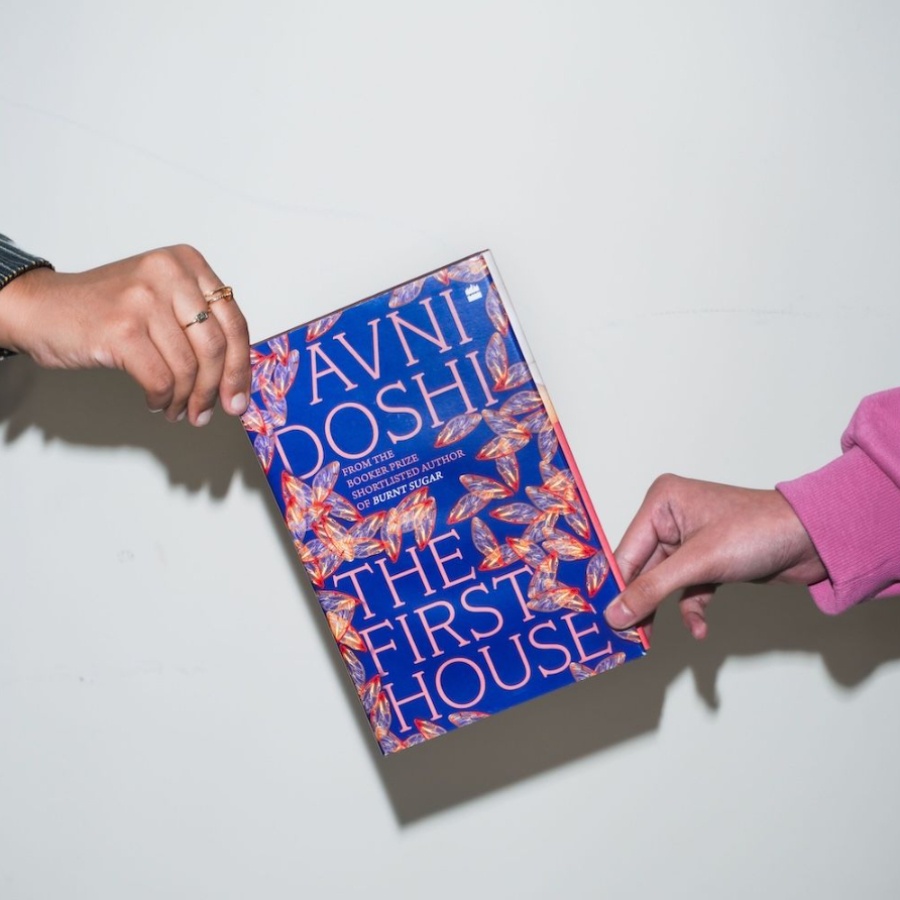




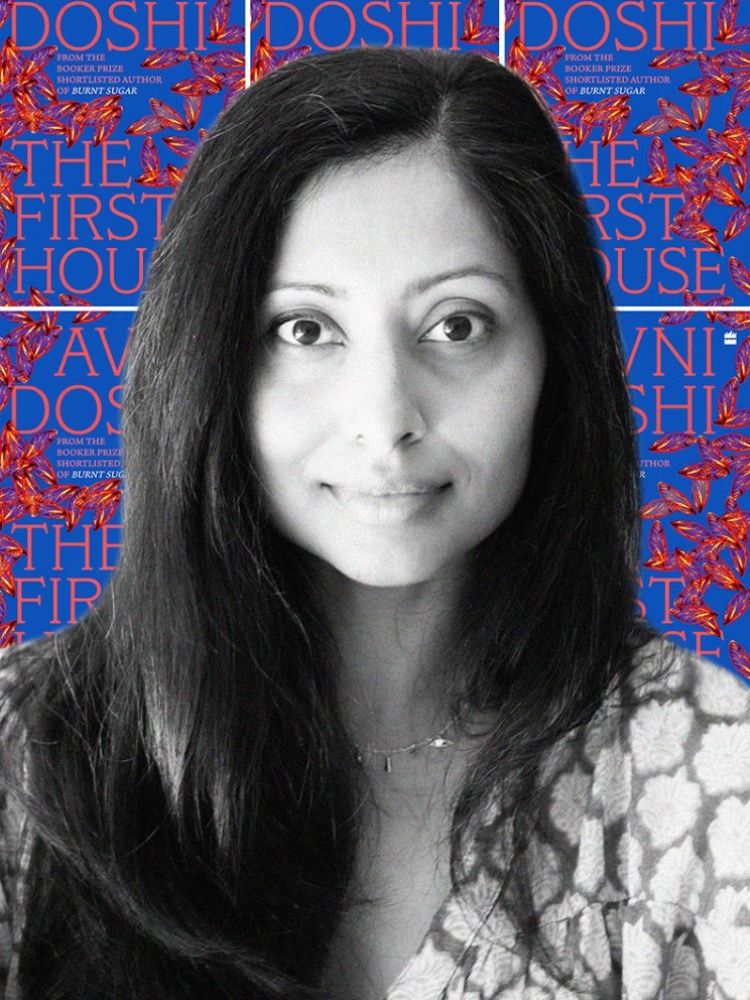

Weeks after her marriage of 13 years collapses, the heroine of The First House, The Nod Book Club’s September pick, notices a statue in her neighbour’s garden. It’s a statue of Diana, the Roman goddess of the hunt who is equated with Artemis from Greek mythology. When she asks her neighbour about the statue, the neighbour says Diana has been there all along. It’s only the heroine who’s been blind to the goddess’ presence.
So begins an awakening, which goes on to feature cicadas, a cat and a credit card that is repeatedly declined.
Avni Doshi’s new novel is about an Indian-American woman first becoming unmoored and then coming into her own. The novel has a few flashbacks in India, shown through a diasporic gaze, but is primarily set in suburban America. Most of the characters are nameless because Doshi wanted them to feel like archetypes in a mythic story. The title refers to the part of the astrological birth chart that represents a subject’s identity. In The First House, the protagonist (who is also the novel’s first-person narrator) secretly studies astrological charts, looking for patterns and revelations. And you can’t miss some similarities between the author and her subject: Like Doshi, her lead used to be a novelist; and like her unnamed protagonist who develops an interest in astrology, Doshi too has been studying astrology since 2014. “I was interested in what we turn to when everything falls apart,” says the Dubai-based author.
Her debut novel, Burnt Sugar, was about an unsettling mother-daughter relationship and included a chilling description of life in an ashram in Pune. (Some of Doshi’s aunts were followers of Osho and can be glimpsed in the Netflix series, Wild Wild Country.) Burnt Sugar was shortlisted for the 2020 Booker Prize. The First House is her second novel.
It may seem like The First House is the latest addition to the popular genre of “divorce lit” and there are striking resonances between Doshi’s novel and Rachel Cusk’s 2012 memoir, Aftermath: On Marriage and Separation. However, divorce was just the starting point for Doshi. Another book that starts with the protagonist’s husband leaving and her shock at his decision is Belle Burden’s Strangers. But unlike Strangers, which chronicles a marriage’s breakdown through a money-charged divorce, Doshi’s novel explores the story of the messiness of divorce, first through an obnoxious husband, and through a financially-wronged woman, who turns out to be an unlikeable lead.
The First House is an exploration of the inner life of women and the cult-like dynamics underpinning everyday life. “Under capitalism and patriarchy, the way we live is as if we are in a cult,” says Doshi, who spoke to The Nod from Dubai. Here are edited excerpts from the conversation.
You finished writing Burnt Sugar when you were 36. Do you remember when you first thought of yourself as a writer?
When I go to my mum’s house now, I see that actually in my childhood bedroom, there are boxes of journals and stories. There’s this one book, a very beautiful journal and it’s been taped up with scotch tape. I’m actually scared to open it because I have a kind of vague memory that my first attempt at a novel is in there, probably from when I was a teenager, and I’ve really blocked it out. There’s something about that I’m still reckoning with because it’s hard for me to accept. If I was so passionate about writing when I was young, how did I forget that?
I think there was a time when I thought of myself as a writer as a child and I’m still trying to figure out what happened, why I really blocked that out.
Did writing The First House feel different from your first novel?
It was very different. I don’t know if that’s because every book is different or if we grow and change as humans and writers. With Burnt Sugar there were a lot of drafts and each one was very different. I just didn’t know what I wanted to do. I think with The First House I spent a lot more time really thinking, before I sat down to write. Now I have a greater sense of how much of the writing takes place before the writing begins. The overarching idea of the book had its own magnetic pull and things were attracted to it. I was just trusting what was being pulled in.
You’d written in a personal essay from 2018, “I worry about losing the crisp boundaries of myself”. I remembered it while reading The First House because in the course of the novel, the nameless narrator seems to find the crisp boundaries of herself. What made you want to write about divorce?
The divorce was a trigger for a larger journey that the character was going to go on. I was thinking of mythic descent narratives and imagining its different layers. At one layer, there’s the divorce. At another, there’s this return to the family of origin and seeing where it all started. Another thing I’m really interested in is the idea of the cult. For me, under capitalism and patriarchy, the way we live is as if we are in a cult. The family is a sort of cult. Marriages can take on cult-like qualities. To some degree, in The First House, I’m returning to an idea that interested me in Burnt Sugar as well—what are the other forms a cult can take? What happens to the person who finally, after being asleep for all these years, opens their eyes and wakes up? How is that person treated within that larger structure? How does this play out in families and in our most intimate relationships? Divorce offered me a way in.
There have been a spate of books, many of them by women writers, about divorce. Were there any that inspired you?
There are novels about marriage and divorce that have been extremely powerful for me. Javier Marias’s novel A Heart So White is always above my desk when I’m writing. Also Katie Kitamura’s A Separation, Elena Ferrante’s The Days of Abandonment. I think in a way I was in conversation with these books as I was writing The First House.
A sculpture of the goddess Diana (Artemis in Greek mythology) by Augustus Saint-Gaudens plays a key role in The First House. When did your love affair with this work of art begin?
I encountered the statue in 2018, in New Hampshire. For a few days I felt I was myself circumambulating this image of Diana and I found her very compelling. I was having really interesting dreams and I was revisiting these mythic stories and I knew that I wanted to write something about her. I just didn’t know what it was.
When it comes to my creative life, I really believe in synchronicity. Some things that happen feel like they are fated. Often I trust intuition more than rational thinking about what makes sense in a story, what the right thing to do is, what the character would rationally do next. When I’m writing, the irrational is more powerful for me.
In high school, I had this incredible teacher who introduced me to Rilke’s "Archaic Torso of Apollo" and I was reminded of it (after seeing the sculpture of Diana). It all just clicked.
In ancient Greece, women knew that if they dreamt of Artemis, it was a sign they were going to die. So I felt that in a sense this (the way the narrator is drawn to Diana) was an extended dream of Artemis in the novel, where the character is going to die. Not a literal death, but more of a metaphorical death and rebirth.
Tell me about astrology. When did you get interested in the subject and why did you want to use it in The First House?
I took my first astrology class in 2014. I found the idea of astrology from an archetypal perspective very interesting, to think of the chart as a story in itself. I’d never really seen a character who had a mythic imagination. What if these are the forms of cosmos that she’s (the narrator of The First House) thinking about, to create cosmos out of chaos? People turn to god, people turn to therapy, people turn to alcohol, people turn to various things. What do we turn to when we’re totally destabilised and what do we try to find that stability in? For her, astrology is one thing. Ancient stories are another.
There was speculation when Burnt Sugar came out that the novel was autobiographical, even though it was far removed from your life. This time, superficially, the first-person narrator has much in common with you. Do you ever think about The First House being perceived as a fictionalised version of your life?
The last thing I want to do when I’m writing is worry about what other people are going to think. That would be such a hindrance for me. It would dilute my work. Many assume that if a woman is writing, she’s only writing from her own experience. Our society has a limited imagination of women’s imaginations. But I will say that things that interest me, certainly find their way into my books. I’m fascinated by divorce, I’m fascinated by motherhood, I’ve always wondered what it is like to have a sister because I didn’t grow up with a sister so I’ve always wanted to imagine these relationships. My books say something about me in that they speak to questions I’m interested in.
You’ve written two novels on the inner lives of women. Does this theme continue to fascinate you?
I’m only interested in women. I heard Ocean Vuong say something a long time ago, which I hold very close. He said the market is about doing something new, but art is about obsession. It’s about grinding deeper, going down further to the core of something. I just found that to be so accurate to my experience. I feel like I can think about women and female interiority and female relationships or friendships, forever... I don’t think I will ever write about men. Who knows? Never say never. Right now, I can’t even imagine it.