



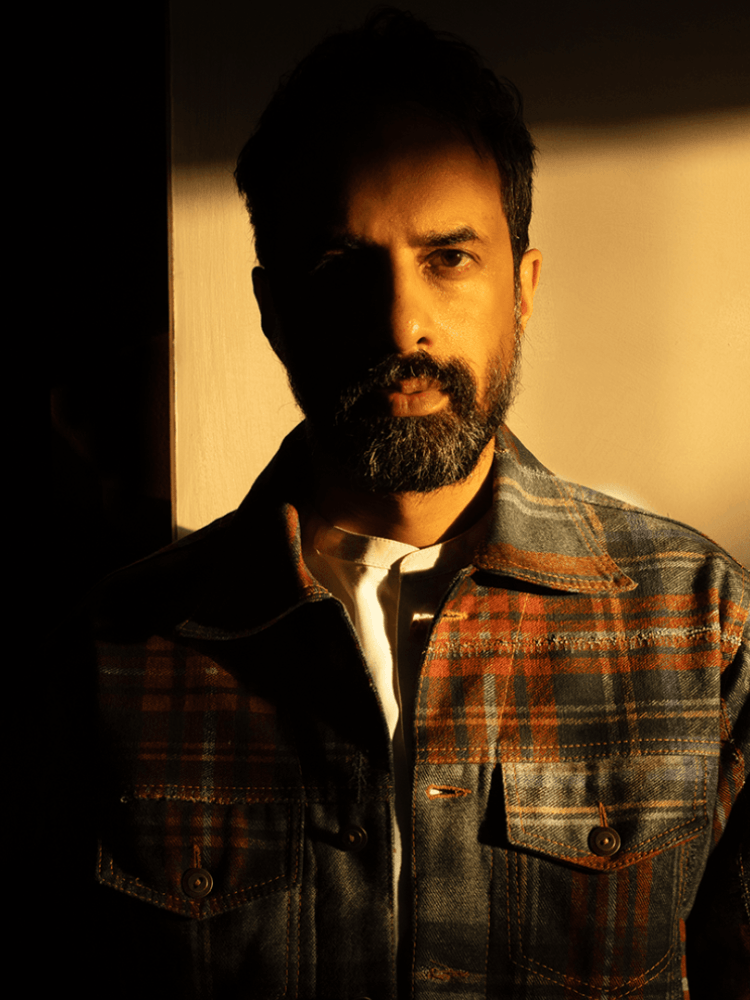

Remember the good ol’ request lines where you could listen to the song of your choice on air? That is, of course, if your call went through. Now imagine a dedicated helpline (of sorts) where there’s always a certain Mr Faarigh—in his deep, smooth voice—ready to belt out a song to help you momentarily forget about your unfinished, unresolved business. There’s one song for those who have been backstabbed, one for calming the voices in your head, and one to discourage you from drunk-dialling your ex. Of course, no one is immune to the most common of post-breakup sins, but I can assure you the laid-back, lo-fi, guitar-driven songs that come on for 30 seconds will shift something in your mind.
The lyrics? Somewhere between poetry and a page from a diary. There’s a chance that all the 100-odd people who have called on the helpline will feel that the little snippet is written for them alone. It’s a familiar feeling that Ankur Tewari—currently masquerading as Mr Faarigh (Urdu for a free, unoccupied, not-so-important person)—evokes with his raw, rooted words that carry the unmistakable ache that has long defined his writing.
In addition to the helpline (+91 95131 68455, for those asking), in the week running up to the release today Tewari held two listening sessions in the Mumbai—Soho House in Juhu and Dimsum Room in Fort—for a small group of friends, collaborators, and fans, away from Bandra’s St Andrew’s Street, where he is, as he joked in the Soho House session, “quite famous”.
The small-town boy from Roorkee first came to the city in 1998, left, and returned in 2003; he’s called Bandra home ever since. Mr Faarigh is Tewari’s third solo album after his previous full-length projects Jannat (2010) and Akela (2023). In the years after Akela, he has kept himself extremely busy. He has served as the creative architect for Coke Studio Bharat seasons one and two, creating some of the platform’s most memorable collaborations, including ‘Khalasi’; co-founded Tiger Baby Records with Zoya Akhtar and Reema Kagti; and was a music supervisor for Netflix originals The Archies (2023) and Kho Gaye Hum Kahan (2023).
But the nine-track album was nowhere on the schedule. A year and a half in the making, Mr Faarigh was born out of the need to fill the brief emptiness that hit anytime a project wrapped up. The album asks and addresses what actually happens beneath apparent inactivity—anxiety, self-doubt, the impossible standards you set for yourself that can make remaining still a lot more frightening, the fear of becoming irrelevant in a world where everything’s moving so quickly, and also what it truly means to be free and unoccupied without guilt. “It’s hard being a full-time musician in the country. It’s a profession full of uncertainties. On the one hand, it takes a long time to build your space in it, and at the same time you have to run a home, you have rent to pay,” he broods when I chat with him over our video call the weekend following the Juhu listening session.
In between all the self-exploration tracks—from ‘Afsos’, ‘Anjaana’, and the title track—sits the most unexpected ode to Bandra, the neighbourhood Tewari has spent knowing and living in since 2003. ‘1:15 AM (Afterhours)’ is a party song that pays ode to the now-shut upmarket watering hole Zenzi as well as the al fresco bar Bonobo, one of the last few “hangouts around the corner”.
Below, Tewari talks about Mr Faarigh, singing rituals, and Bandra things.

What does a week before an album release look like?
Like the last lap of a marathon. It is lined up with interviews, radio runs, listening sessions. It’s busy. I try to keep the release day as normal as possible—breakfast, coffee, maybe a workout. It makes me feel grounded.
Who (or what) is Mr Faarigh?
He is an alter ego. ‘Faarigh’ in Urdu means ‘idle’, ‘unoccupied’. You can use it as ‘faarigh ho kar milenge’ or as a slang for a person who is free: ‘bada faarigh aadmi hai’. The word investigates idleness and procrastination. It is, at once, a yearning for free time and productivity and everything in between: the guilt about enjoying free time, the anxiety to fill it with something productive, and also the wish to occasionally be irresponsible and “waste time”. You want to be part of the hustle culture while also needing a creative pause. So, it's kind of a toxic mix.
The first track, ‘Kasam Se’, is about dealing with heartbreak. It’s a recurring theme in so many of your works. Does it come from somewhere within you? Have you been hurt too many times?
I have been heartbroken a bunch of times and it’s different kinds of heartbreaks. It’s [being] heartbroken with how there is no justice in the world. You sometimes feel heartbroken in your love life, sometimes with friends, sometimes with just a stranger. ‘Kasam Se’ particularly addresses how with each heartbreak you kind of change, become more ‘clever’, maybe harden up or eventually feel jaded. The song is about the hope that you never get jaded. The line ‘Would you fall in love again as if your heart has never been broken?’ inspired the song.
Every creative from Mumbai has a Zenzi story. With ‘1:15 AM (Afterhours)’ you have put Bonobo and Zenzi (and Bandra’s erstwhile party culture) front and centre.
There are a lot of metaphors in the album, but I wanted a direct song, too. I always regretted that I never wrote about Zenzi [before or after its shutting down in 2012] or the parties there. These are interesting cultural moments in our lives and show how our world is changing so rapidly. At some point, these complicated times might feel simpler, but I wanted to catch the innocence and the vibe that’s around right now and document it.
Thematically, the song is about losing yourself through the night so you could drown the voices in your head. I visit Bonobo often and I love that they have live nights every Wednesday and interesting electronic artists coming in often. The gate fee is not that much either. It’s a good vibe and the lyrics say exactly that.
As fun as it sounds, what’s a party song doing in an album full of moody numbers?
I hear you. People often have an impression that I’m a very serious guy, always frowning. They think I’m always angry. But I do have my share of fun and I wanted to put that side of my personality into the album as well. I don’t like the idea of genres, because that’s how people try to teach themselves and the gatekeepers try to cage you, but I also try and break those boxes on and off.
The composition of ‘Afterhours’ is also as if you’re singing at a party. I wanted to get that flavour of joy that you have when you sing together—some would be off-key and some in key. In ‘Aazma Lo’ too, the group vocals are not all in tune and harmony, but I wanted to get that feeling.
What’s the most Bandra thing that you do?
Go to an Irani cafe, like Good Luck, and share a table with strangers.
For the video, which looks very natural, did you have friends over and shoot it?
They are all actual locations. It is a friend’s house that I love for all the gadgets he has. There’s a Bonobo bit that’s shot in there. Then there’s a whole verse about an after-party in the home of Tej [Brar, a friend], which we shot in Tej’s house. I got some booze, invited a few people, and we shot for a couple of hours, and we had a party. Then we shot some on the streets. Sachin Pillai made a rig where he could put the camera on his helmet and move around with it. Then my friend Sameer Gauri, who has been shooting a lot of casual, fun stills in different areas, was kind enough to pass his stills to us. We made a collage of those and shot everything else on an iPhone.
In what language do you think of a song?
Hindustani. I would never write my poetry in English. It’s horrible. I’ve been told it’s like a Hallmark card. I don’t—I can’t—think in English that well.
‘Yakeen’, you say, is an older protest song that you have added to the album. What did you have in mind when you started writing it? Did the recent Gen-Z protests play a part here?
It is a protest song where authorities come down hard on you and you feel defeated. It’s a song for all the people who believe, those fighting for their rights even though they’re squashed. It’s a song to kind of reassure them that their voice will be heard. Whether it’s a fight against cops who police pure joy, like sitting on Carter Road, or [those at] major protests, like the recent CJP-led one where students got beaten up in Delhi. Whether it’s Umar Khalid, who has been in jail for six years without a trial, the brutality that the governments around the world show to their people, or what's happening in Gaza… The lyrics try to say I may be feeling defeated today but my belief will change your belief, because I believe in love.
When and where does inspiration strike?
My best ideas have come to me when I am not looking for it. At a party, on a plane, sitting in a cafe eavesdropping on other people’s conversations. It could be anywhere.
Do you maintain a diary?
I need to put pen to paper to get whatever I am feeling or thinking out of my system. But I don’t have a diary (I know I should), but I’m sure that I’ll forget it somewhere or forget to carry it most of the time. So, I scribble on any piece of paper I get—an electricity bill, a building notice...
Do you have a singing ritual?
I think I just need to calm my nerves. Depending on where I am, it could be just sitting in silence for a bit or a shot of tequila before you hit the stage. It pushes all the unnecessary thoughts out of your mind and preps you to submit yourself to the performance.
Mr Faarigh is available on major streaming platforms like Apple Music and Spotify