



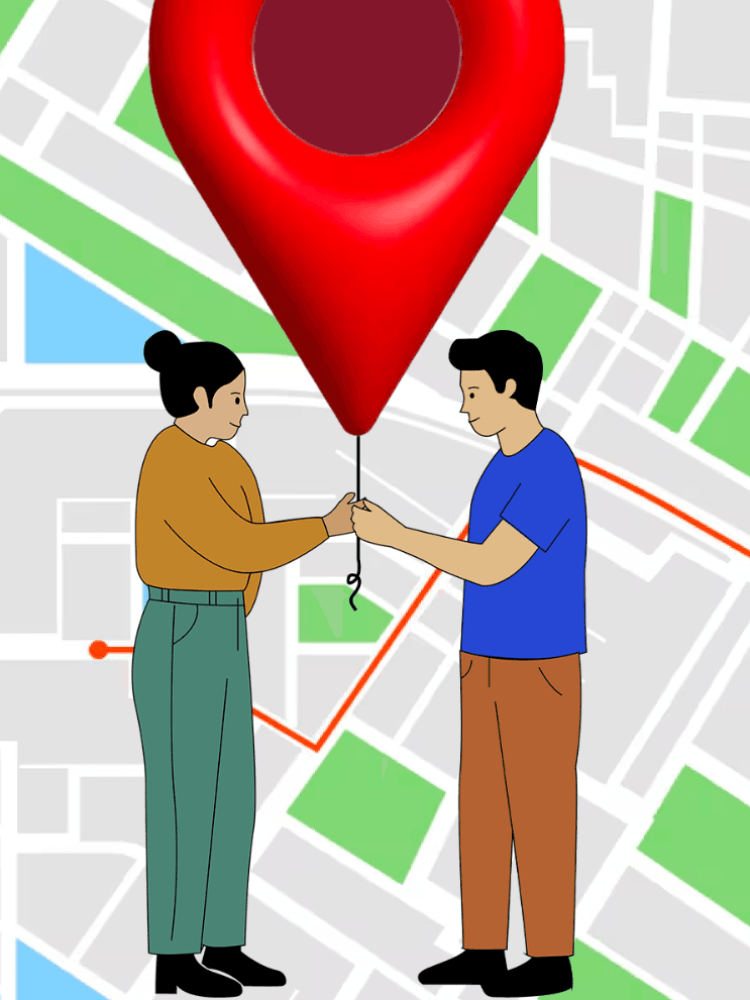

In the recent Netflix comedy Best of the Best, besties Anjali (Priyanka Kedia) and Maya (Maitreyi Ramakrishnan) are in the middle of a fight when Maya pulls the ultimate act of war: she turns off her location sharing. For a generation who grew up with AirTags and apps like Find My and Life360, this move was the sign that their relationship was truly at breaking point. After all, if you’re not letting your closest people keep tabs on you at all times, do they even matter to you?
For most Indian women, location sharing started as a safety feature, but among Gen Z friend groups, it’s transcended that to become the ultimate expression of loyalty. For Aadi*, a student in London, being open to location sharing is “a way of saying ‘I’m thinking of you’.” The 20-year-old adds that for him, it doesn’t even have to be a two-way street. While everyone may not be open to sharing their location, he feels that those who do are people who trust him more in some ways.
For Bhagyasharee Birje, there is an intimacy to being an ever-present blob on someone else’s map. The 23-year-old credit risk analyst from Mumbai believes that sharing her location with her inner circle of nine not only keeps her accountable, it also helps her stay positive. “These dots are like a representation of how the city is actually filled with people I love. Sometimes I just like to zoom out on the map and see them spread across the world. It just makes me think that the world has people I love, so maybe I can love the world for what it is as well.”
Beyond what it signals, there are benefits to this form of consensual stalking. Tanya*, a 25-year-old Delhi native, says that she mainly shares location with friends as a safety measure. Life360 proved especially useful when it immediately notified her of a friend’s (minor) car accident, and she was able to make sure they were okay.
Side note on the apps: Location sharing is built into the Apple ecosystem with Find My. But there’s also Life360, a GPS-enabled tracking app that reported 50 million-plus users in 2025 in America alone. The app not only shows you where someone is at a given moment, it also notifies you of their drive diagnostics, battery levels, and comings and goings—all in real time. Of late, Instagram is the hot new bombshell entering the villa with Instagram Map.
“When my friends started going out on dates from dating apps, we were just scared for their safety, you know, living in Delhi and everything. Then I eventually moved to Durham, and I was like, ‘In case anything happens, you guys have my location. You know who to call,’” says Tanya. The legal IP trainee also hopes those who have her location will notice when she’s hibernating for too long or side-questing somewhere random, in case of an emergency. She trusts them to do something if she goes AWOL or if they don’t hear from her for a while.
The instinct to keep your people within arm’s reach grows stronger when things feel uncertain. During the recent protests in Delhi and Mumbai, location sharing became a practical way for friends to look out for one another. Priya Thakur, 30, and Gurnoor*, 22, shared their locations with offsite teams coordinating those on the ground in Jantar Mantar, in case they were detained. “There is a team of people who work offsite to coordinate with the ones who are at the protest to account for everyone in a group. This protest was an especially important one to share locations for because detainments were arbitrary. The police themselves didn’t know where to take the detained because all detainment centres and police stations were filled up. During that time, whoever snuck their phone in or had it on them would send their location so that the offsite team could alert a lawyer and follow the route to reach the detainees as soon as they are stationed somewhere,” says Gurnoor.
A similar situation unfolded at the Mumbai site, where Swara Shettigar, 26, noticed that while she had around half a dozen people tracking her location from the outside, others were attending alone. “It’s a privilege to have somebody in life who actively asks for your location. I know there were people at the protest site who were just there for themselves and their futures, and nobody back home had their location,” she says.
Having someone looking out for you also makes it easier for some in this generation to let loose when they go out. When Aadi sees his friends have been at the pub for too long, he likes to go pick them up or at least keep an eye on his minions, as he calls them, until they safely reach home.
While safety is not her first priority, Birje is also cognizant of the fact that someone in the world should know where she is—especially when she lies to her family about it. “Sometimes I might lie to my parents about what I’m up to. So, this group of people knowing where I am really makes a difference.”
Aneri Mayer, a furniture designer from Ahmedabad, also agrees on the safety aspect, only choosing to share her location with a select five people. But she believes that over time it has also become a way to stay connected without forcing conversation every day. “It is a form of intimacy for our generation, especially with everyone being in different cities or even continents. It’s fun to see what they’re up to.”
For The Nod’s stylist Naheed Driver, the practicality plays a pretty big role. While Driver is notorious for micro-stalking, she’s also a self-proclaimed bad texter. So, it’s easier for her friends and colleagues to just check where she is instead of attempting to get in touch with her. Plans are easier to make since interested parties can now skip past the “What are you up to?” questions entirely and move on to “I’m down the street from you. Shall we sneak away for a coffee?”.
Both Birje and Tanya find it convenient to check where someone is before reaching out. “It’s more about just being transparent with our friendship. It’s so easy on social media to fake that you have this life where you are going out every day. Sometimes it’s not even in real time. I find it really comforting to know that if I open Find My at some point and all of my friends are at home, then I can just call them up. There’s a comfort in knowing that we’re all bed-rotting together,” says Birje.
How far can you go?
Of course, this transparency can also backfire. For one, you could end up getting caught doing something that your friends might not approve off, which is something Driver witnessed. The zillennial—who openly admits to her love for keeping tabs on her friends—accidentally came across a friend secretly visiting their ex. “She had not told any one of us that she had got back with him. So, the next day, all the girls drilled her together,” she shares.
Other times, you may want to tell a little white lie about your whereabouts for a moment of quiet. So, either you share your location with only a select few or you submit to a life of being constantly micro-stalked.
We are also yet to figure out the etiquette of unsharing our locations if the friendship goes sour. Should one be offended if someone pulls an Irish exit from their map? Driver doesn’t think so. As someone who shares her location with 24 people (and, as a result, constantly has a low phone battery), Driver believes she wouldn’t even realise if someone dropped off without notice. Birje, however, says it would make her sad because it’s a concrete sign of no longer being close.
But being close with someone doesn’t always warrant a healthy relationship.
Tanya points out the obvious dark side: “People can figure out what your daily routines and patterns are if they have your location, and that can be a bit intrusive. I obviously don’t want people to get my location if I’m not super close with them. Whoever has my location, they shouldn’t misuse it or use it to control me or the relationship. That has been done to me in the past and has been very nerve-wracking and scary, to say the least. So, I think, while location sharing is a form of intimacy, it's also a big form of trust, which goes hand in hand, really.”
There is a thin line between surveillance and lovingly checking in each other, depending entirely on who is on the other side of the screen. For Birje, location sharing began as a way to stay connected with friends while travelling. They could see where she was on the map and send recommendations accordingly. For Tanya, however, a similar gesture felt invasive. After falling out with a friend, she found herself being tracked on holiday and receiving unsolicited recommendations from someone she was no longer close to.
That’s the interesting thing about location sharing: the same feature that lets someone map your daily routine can also reassure you that your friends are home, safe. With all its potential for surveillance, this Sims-esque phenomenon might tell your friends where you are, but real intimacy lies in knowing whether you can trust them with it.
*Full name changed/withheld upon request