



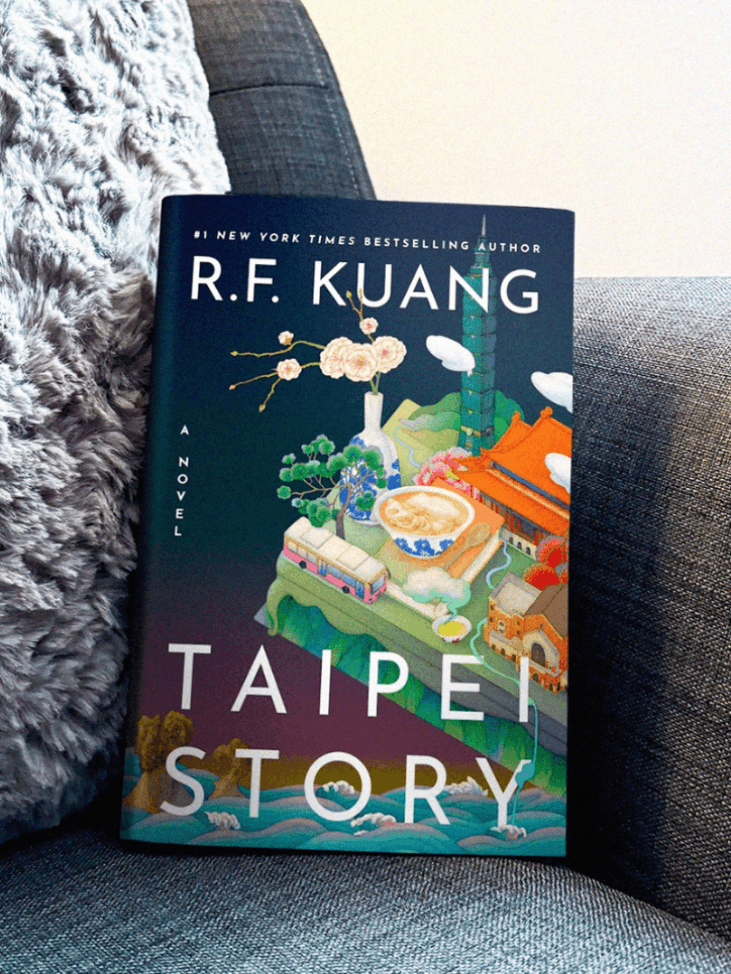

RF Kuang really does like making life difficult for her characters. After sending them to war, trapping them in an alternative version of Oxford and, most recently, dropping them into hell, she has now sent one to Taipei with a stack of Mandarin flashcards. A new Kuang book is an event for me; I plan my reading around it. So, after Katabasis last year, I was very excited to see what she would do next. Published by HarperCollins and out today, Taipei Story is a quieter book but also her most personal one yet.
Lily Chen, a 19-year-old Chinese-American Yale freshman, arrives in Taipei for an intensive summer Mandarin programme, a rite of passage that many diaspora kids from Ivy leagues go through, after spending most of her life in the US. More comfortable in English, she has convinced herself that Mandarin is something she can fix if she works hard enough. But there is more at stake than getting through her classes. Lily is trying to figure out where she fits and how much of her identity is tied to a language she can barely speak. She expects a summer in Taiwan to bring her closer to that part of herself. Instead, it mostly makes her realise how far away she is from it.
That feeling was familiar to me. I grew up Malayali in a city where Malayalam wasn’t really the language of my everyday life, while my family was juggling three or four languages at once. I knew I was supposed to know my mother tongue better than I did, but it was never something I consciously chose not to learn. It just never happened. Moving back to my hometown during university was a shock because suddenly I was surrounded by a culture I had always considered mine while realising how much of it I had experienced from the outside.
Lily gets a similar shock in Taipei. The classes are intense; she struggles to keep up and quickly realises that being Chinese doesn’t automatically make Mandarin come easily to her. She keeps approaching the language like an exam she can ace, while the city throws things at her that cannot be solved with another hour of studying. Her roommate, Anna, is one of these sources of friction, with the two constantly getting on each other’s nerves over noise, groceries, sleep, and personal space, while their mutual interest for a boy in their programme, JC, only adds to the gossip fodder in the department.
Her grandfather dies during the programme. Lily had come to Taipei partly to improve her Mandarin so she could speak more easily with her grandparents. She assumed there would be time to become fluent, ask questions, and learn more about her family. Suddenly, there isn’t.
Kuang has spoken about how closely this follows her own experience: she, too, was studying Mandarin in Taipei in 2023, when her grandfather died, and she has spoken about regretting that she wasn’t able to have the conversations with him that she wanted.
That is where the book’s questions about identity become much more personal for anyone who has ever felt caught between where they come from and where they feel at home. There is a particular kind of guilt in knowing that language was one of the things standing between you and the people you loved. You tell yourself you’ll learn properly one day, ask those questions later, have that conversation when you’re less embarrassed. I felt some of that when I moved home and realised how much I had missed simply because I couldn’t communicate as easily as I wanted to. Taipei Story understands what happens when “later” runs out.
Language is, unsurprisingly, where Kuang gets to have the most fun. Babel (2022) was obsessed with translation, etymology and the power contained in words; here, she gets into the mechanics of learning one. Lily spends pages working through Mandarin grammar, trying to understand characters and figuring out why something that looks perfectly logical, just isn’t. There are Chinese characters you may not recognise, and Kuang doesn’t always stop to translate them. You might reach for Google Translate or simply trust that you’ve understood enough and keep reading. She doesn’t spoon-feed you, which means you occasionally find yourself thinking, I have absolutely no idea what this means, and turn the page anyway. Kuang lets you experience the tedium of learning a language rather than rushing Lily from one breakthrough to the next.
She also makes tiny observations about how language changes people. Lily notices that Anna seems much sweeter when speaking Mandarin, while English brings out a sharper, more sarcastic version of her. Anyone who has grown up switching between languages will understand this immediately. You can sound different, joke differently, and even become a slightly different person depending on the language you’re speaking.
And then there is Taipei itself. So much of the book is made up of ordinary things: waking up, going to class, doing homework, working from cafes, cycling around the city, getting food, and going home. There is the humidity, the tofu pudding breaks between classes, and all the little details of figuring out how to exist in a new city. Lily can spend a morning worrying about an assignment and an afternoon wandering around Taipei, and that is pretty much it. Compared with Kuang’s other books, where something enormous is usually happening, Taipei Story feels deliberately uneventful.
The book is also a departure from Kuang’s fantasy-heavy books, but Taipei Story still feels unmistakably hers. Language, culture, power, and belonging remain at its heart, only this time within a much smaller story about a girl trying to find her place between cultures. It is the kind of read that can hit surprisingly close to home.
Taipei Story is published by HarperCollins India; ₹496