



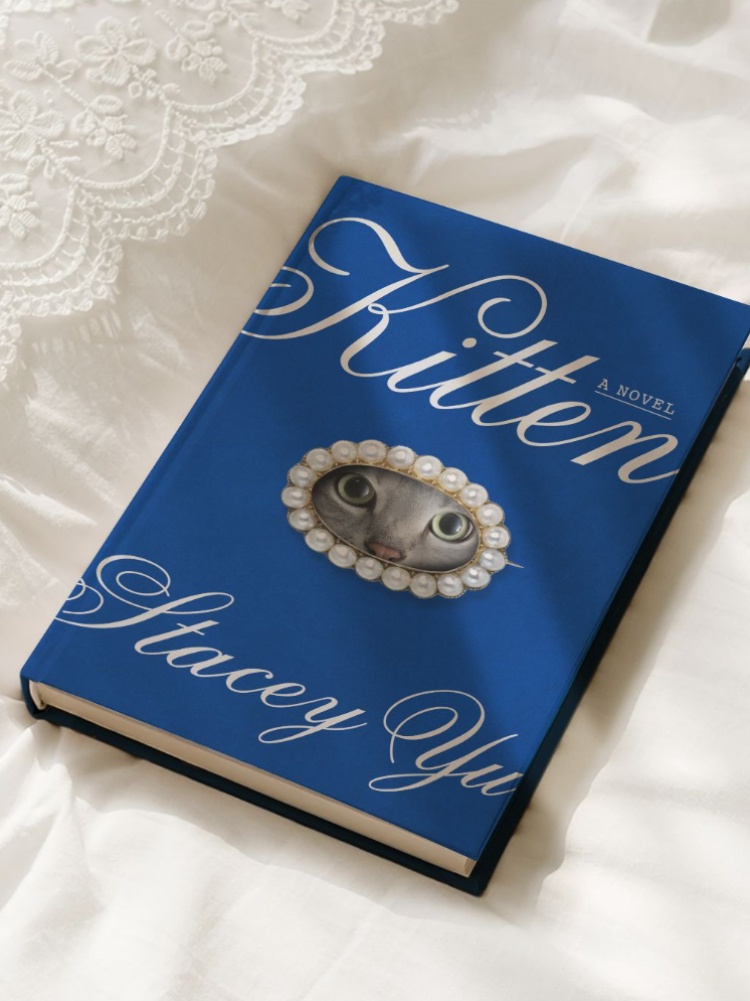

The first thing that made me pick up Kitten by Stacey Yu was, as much as I hate to admit it, the cover. That deep blue background, the slightly old-fashioned lettering and, right in the middle, a cat’s face framed by a string of pearls. It’s hard to look at that and not want to pick it up. I’d seen it earlier this year when the book was first announced, then watched it pop up everywhere on BookTok and literary-girl reading lists. Yu is already quite well known in the book community for her reviews, so I was curious about her debut. Marketed as a weird-girl read, Kitten, released earlier this month, is a 294-page novel about reaching your twenties and realising nobody is coming to tell you what to do next.
Katie is 22 and fresh out of college and, frankly, not doing very well. She needs a new job, her roommate is about to take over the apartment, and she hasn’t spoken to her mother in about a year. All of which Katie has been avoiding dealing with. The idea of her being a capable, functioning adult seems so ludicrous that she barely bothers trying. She has essentially frozen herself in a state of apathy.
Then her boyfriend, James, invites her to spend two weeks with him and his beloved cat, Silver, at his family’s seaside home in Holme. Silver becomes the centre of Katie’s attention, partly because she genuinely loves the cat but also because she is fascinated by how easy Silver’s life seems. She gets fed, cared for, and protected. She doesn’t have to earn anything, explain herself or figure out what comes next. Katie looks at her and thinks, “How lovely to be so helpless.” And that really gets to the heart of the novel. Katie doesn’t just want the cat. She wants the life the cat gets to have.
That is where Kitten gets really interesting. Katie’s helplessness is not exactly cute. It is annoying, sometimes funny, and occasionally quite alarming. For example, the time when she desperately needs to pee during a car journey but cannot bring herself to ask James to stop, eventually wetting herself in the car. Can’t really say we’ve all been there... She’s also perfectly capable of driving, and James is surprised to learn that she can, because she has been happy to let him drive her everywhere. She can’t seem to make the simplest decisions about her own life, but when it comes to Silver she becomes remarkably determined, eventually becoming so attached to the cat that she essentially refuses to accept that she might have to leave her behind.
The frustrating thing is that some of this feels painfully familiar. We’ve all had moments when we know exactly what we should do and still find it easier to ignore the email, avoid the call, or let life happen to you. Katie just takes that feeling much further.
You can see the lighter version of this impulse all over the internet. “I’m just a girl” when you don’t want to do something, girl dinner when you can’t be bothered to cook, little treats when adulthood feels bleak, passenger-princessing your way through life or announcing that you’re looking for a man in finance and calling it a day. Most of it is harmless internet silliness or a satirical response to the “boys will be boys” lifestyle. But Kitten asks what happens when the joke becomes your primary worldview.
Yu’s ‘girlbaby’ is such an interesting idea to put at the centre of a novel. She positions it as the antithesis of the girlboss that was sold so heavily to millennials. The girlboss was told to hustle, lean in, and have it all. The girlbaby has grown up watching that promise fall apart and is more likely to think, why bother? When rent is ridiculous, jobs are precarious, and owning a home feels impossible, opting out can seem more appealing than being told to work harder.
Kitten also makes for a nice companion to Yesteryear, one of the biggest book phenomena of the year. Both are interested in women trying to navigate the same system from completely different directions. In Yesteryear, Natalie believes she can manipulate the patriarchy from inside it. She thinks she can learn its rules and use them to her advantage, until she discovers that you cannot necessarily manipulate your way around a system that was never designed for you to win. Katie, though, doesn’t even want to play. She would rather get in the passenger seat.
And that feels like a pretty timely question: if the girlboss was sold the fantasy that she could control everything, what happens when the next generation decides it is easier not to try at all? For anyone who has been chronically online, there is something recognisable here. When you are constantly absorbing memes, consumerist aesthetics, and internet identities without stopping to question what they are teaching you about yourself, it can be surprisingly easy to internalise them. Kitten is a funny, strange reminder to pause every now and then and ask whether the things making us feel comforted are actually helping us grow up.
Kitten is published by Hachette India; ₹1,799